
Reducing the growing environmental impact of the computing industry requires assessing the emissions of electronics at scale. However, a traditional life-cycle assessment (LCA) of an electronic device, which maps materials and processes to environmental impacts, often requires proprietary or unavailable data. Here we report a multimodal multi-agent artificial intelligence system that emulates the collaborative process between LCA professionals and stakeholders (such as product managers and engineers) to estimate the carbon footprint of electronic devices. The agents iteratively construct a complete life-cycle inventory by leveraging a structured data abstraction and software tools that mine information from the public Internet, including repair communities and government regulatory databases. This reduces data gaps and data collection from weeks or months of expert time to under 1 min. The system can calculate the carbon footprint within 19% of expert LCAs with zero proprietary data (typical of the variation between human LCAs). We also show that by encoding domain-specific knowledge, environmental impact estimation can be reframed as a data-driven prediction task, in which both unknown products and emission factors are represented as weighted combinations of similar ones with known emissions.
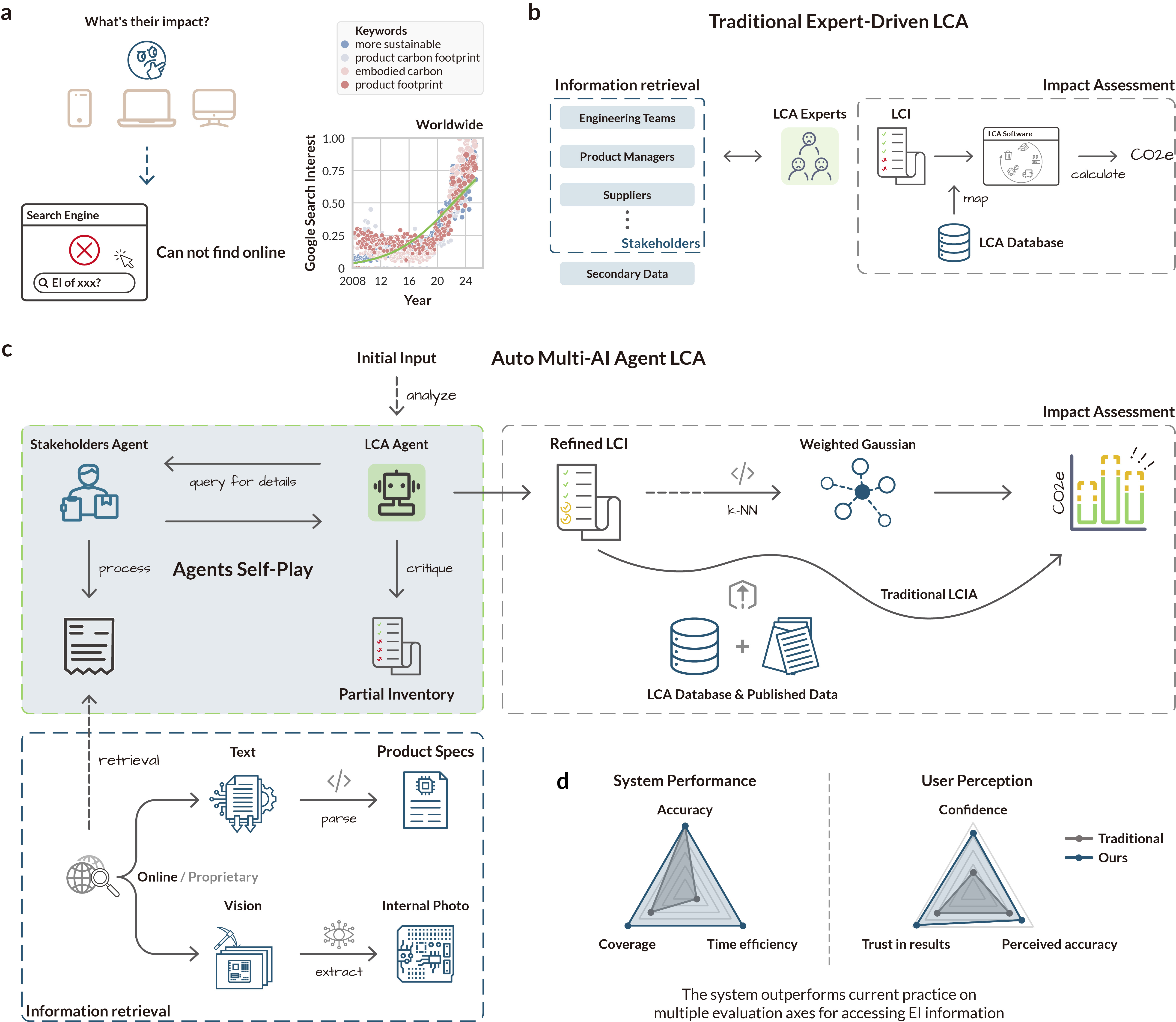
Autonomous LCA using multi-agent self-play. a, Google Search trends for sustainability-related keywords from 2008 to 2025, highlighting the growing public interest in considering EI in daily lives. However, critical EI information remains largely unavailable, especially for electronic devices. Search interest score is normalized monthly, with a value of 1 representing the peak popularity of the term. b, EI is traditionally assessed via LCA, a manual, expert-driven process. LCA experts construct a LCI by identifying all components involved throughout a product's life cycle, requiring manual collection efforts, coordinating multiple stakeholders within the company and external suppliers, and then mapping each entry in the LCI to an emission factor in databases. c, An autonomous multi-AI-agent system capable of generating LCIs for real-world products and estimating their EI. The system simulates the traditional LCA process at scale through a multi-agent self-play environment in which an LCA expert iteratively refines the LCI by consulting with a variety of stakeholders representing different knowledge and expertise through iterative querying and dialogue. The refined LCI can be used for standard LCIA to deliver a final EI, or for estimation using a weighted sum of similar objects with known emissions based on domain-specific features. d, Proposed system outperforms current practice in both technical performance (for example, time efficiency) and user perception (for example, confidence in accurately finding EI information) compared with conventional search approaches.